
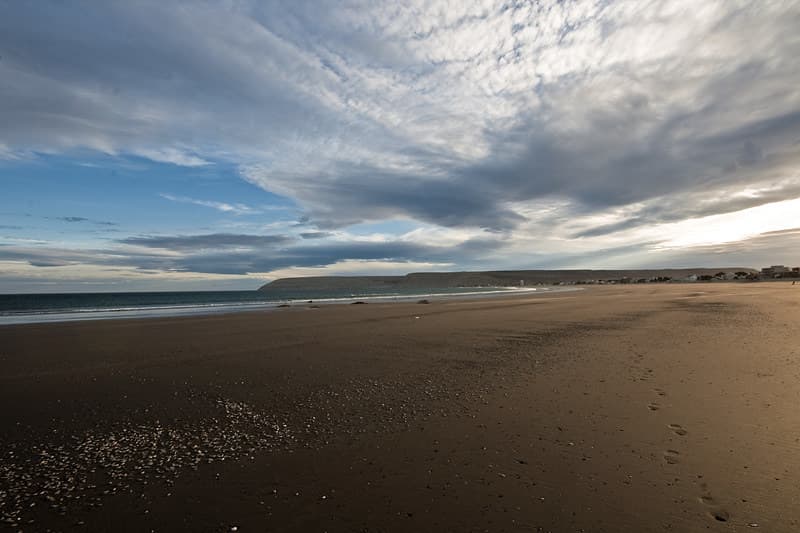
The sand here carries the charcoal tint of ancient volcanic ash, darker than the blonde beaches of the north, and it holds the afternoon warmth even when the Atlantic wind picks up. You're standing at the edge of the Chubut coast, where the Patagonian steppe doesn't gradually transition to sea but simply ends—low bluffs capped with tussock grass, then nothing but waves rolling in from the Southern Ocean. Families stake out spots near the natural windbreaks formed by rounded stones and weather-worn logs, unpacking thermoses of mate and nylon kites that snap and dive overhead.
“This is the only beach where Patagonian steppe meets the Atlantic with volcanic sand underfoot and endless sky overhead.”
 Credit: Flickr
Playa
The scenery opens wider as you walk south toward Punta Marqués, the headland dark against the pale sky, seabirds wheeling above the tideline where kelp glistens in matted piles. The water stays cold year-round—fifteen degrees Celsius even in summer—but that doesn't stop the determined swimmers who dash in, shrieking, then retreat to towels weighted down with shoes and beach bags. The light here shifts fast: one moment flat and white, the next slanting gold through a gap in the clouds, turning the whole beach amber.
You won't find beach clubs or thatched palapas. What you will find is space—enough to spread a blanket without hearing your neighbor's conversation, enough to let children run until they're distant specks, enough to remember that some coastlines still belong more to the wind than to us.


