
Counting the waves…
Counting the waves…
A refined fusion of water purity, environmental stability, and communal vibrancy for Playa Caleta de los Loros Sur.
View MethodologyAnalyzed via live sensors and environmental data.
Wave height, wind, and atmospheric stability.
Live footfall and crowd balance metrics.
Community reviews and curated sentiment.
“You'll smell the salt-and-kelp tang before you glimpse the turquoise shallows tucked behind basalt headlands. Playa Caleta de los Loros Sur trades the drama of open-ocean breaks for mirror-flat water that holds the…”
Limited recent visitor reports — live OBI telemetry is your best guide for current conditions.
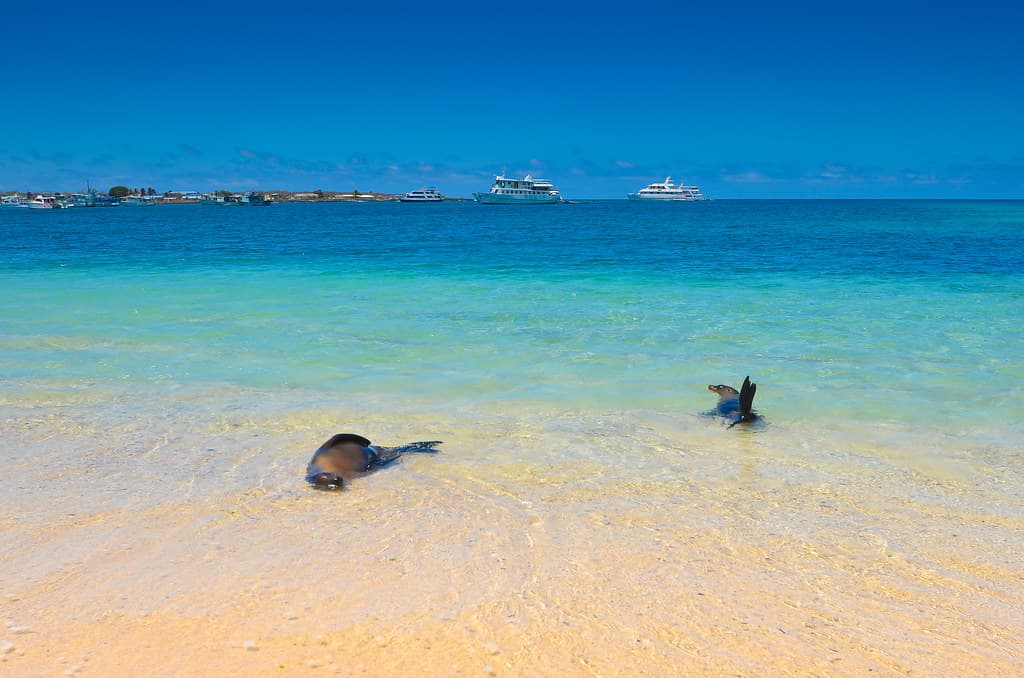
The gravel road forks north of Puerto Lobos, and most travelers miss it—they're chasing the fishing pier or the seal colonies farther south. Follow the rutted track another four kilometers and you'll drop into a sheltered inlet where the South Atlantic behaves more like a Patagonian fjord. Basalt boulders, smooth as river stones, line the shore; behind them, scrub gives way to rust-red cliffs that trap warmth even on blustery days.
You wade in without wincing. The lava shelf breaks the swells offshore, leaving only knee-high ripples that barely disturb the sand. Families spread blankets on patches of wild beach grass. A few yards down, a pair of kayakers paddle toward a cluster of cormorants drying their wings on offshore rocks. The water stays shallow for thirty meters, warm enough in January and February that you forget you're below the 41st parallel.
Crashing wave at sunset on the shoreline
Warm shallows, no undertow
Flat water, offshore rookeries
Basalt turns copper-red
Prime Visitation
Less Crowds
Where it is
Playa Caleta de los Loros Sur
Puerto Lobos, Río Negro, Argentina
-41.950800°, -65.041300°
Weather
Loading…
Swell
—
Temp
Warm · Restorative
UV Index
Moderate
Wind
—
Tidal State
Last known
Max Sunlight
—
Ideal Shade
—
Jan - Dec (Peak)
Mar - Nov (Off-season)
Historical data suggests peak visibility and stable sea temperatures occur during the prime visitation window.
Select a category to load nearby places.
Unlock restaurants, luxury stays and curated maritime experiences within 2km
Playa Caleta de los Loros Sur generally offers calm water conditions suitable for swimming, thanks to its sheltered caleta configuration. However, safety depends on specific weather, tides, and currents. No lifeguard services operate at this remote location, so swimmers must assess conditions independently and swim at their own risk. The calm-water designation suggests reduced wave action compared to exposed beaches, but caution is always necessary. Never swim alone in remote areas, and avoid entering the water during rough weather. The isolation means emergency assistance would be significantly delayed, so conservative judgment is essential.
For sunset viewing, visit between late spring and early autumn (November through March) when days are longer and weather more predictable. Summer months (December-February) offer the latest sunsets with warmest temperatures for comfortable evening beach visits. The western exposure of Argentina's Atlantic coast creates beautiful evening light across the water. Late afternoon arrivals allow time to explore before sunset. Autumn (March-April) provides excellent sunset conditions with fewer insects and pleasant temperatures. Winter sunsets occur earlier and can be dramatic but quite cold. Clear weather days are essential for best sunset viewing; check forecasts before making the journey.
Playa Caleta de los Loros Sur is located north of Puerto Lobos along Río Negro's remote coastline. Access requires a sturdy private vehicle capable of handling unpaved roads. From Sierra Grande, travel south to Puerto Lobos (approximately 150 kilometers), then continue north along coastal tracks to reach this isolated beach zone. Total journey time is typically 2-3 hours depending on conditions. Roads may be rough gravel or dirt; navigation is challenging with minimal signage. GPS coordinates are highly recommended. Ensure adequate fuel, spare tire, and emergency supplies as this is extremely remote territory with no services.
This remote beach has no facilities. Puerto Lobos, the nearest settlement to the south, is extremely small with minimal infrastructure; it may have very basic accommodations or allow camping, but services are scarce. Sierra Grande, roughly 2-3 hours away, is the nearest town with reliable hotels, restaurants, and shops. Visitors should plan as a wilderness day trip, bringing all necessary food, water, and supplies. There are no restaurants, stores, or services anywhere near this isolated beach. Complete self-sufficiency is required. Consider staying in Sierra Grande and making early-morning trips to enjoy sunrise or late-afternoon visits for sunsets.
The name "Caleta de los Loros" (Cove of the Parrots) suggests the area may historically have been associated with local bird species, though specific wildlife varies seasonally. Argentina's Patagonian coast supports diverse seabirds, shorebirds, and occasionally marine mammals. You might spot cormorants, gulls, terns, and other coastal birds. The remote, undisturbed nature of this beach creates good wildlife habitat. Tide pools may harbor marine life. Sea lions occasionally visit Patagonian beaches. The best wildlife viewing typically occurs during early morning or late afternoon when birds are most active. Bring binoculars for better observation while respecting wildlife from appropriate distances.
Photos