Counting the waves…
Counting the waves…
A refined fusion of water purity, environmental stability, and communal vibrancy for Flinders Beach.
View MethodologyAnalyzed via live sensors and environmental data.
Wave height, wind, and atmospheric stability.
Live footfall and crowd balance metrics.
Community reviews and curated sentiment.
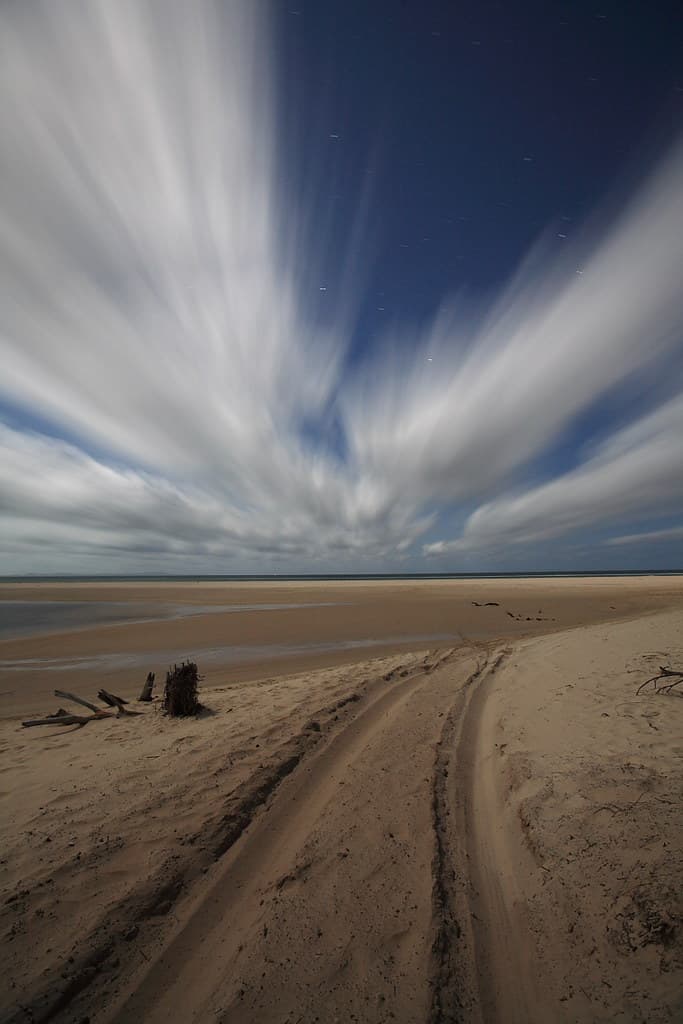
“You'll feel the bounce of deflated tyres on compacted sand as you navigate the track through coastal heath to Flinders. When the vegetation peels back, a bone-white ribbon of beach unfolds north—so long you lose sight…”
Limited recent visitor reports — live OBI telemetry is your best guide for current conditions.
The drive itself filters out the casual beachgoer. Beyond Main Beach's sealed roads, Flinders Beach requires lowered tyre pressure, a 4WD permit, and the nerve to trust that soft patches won't swallow your axles. But once you've cleared the paperbark canopy and rolled onto the firm sand near the surf line, the payoff becomes clear: eight kilometres of uninterrupted shore where campers pitch swags beneath the stars and families stake out private stretches wide enough for cricket pitches.
Unlike Point Lookout's headland-framed coves, Flinders offers oceanic scale. Banksia woodlands frame the back beach, their gnarled branches softening into she-oak groves that hiss in the nor'easter. The beach faces east, catching swells that march in clean lines toward shore, but the absence of rocky headlands means currents demand respect. Locals plant their rods at dawn, casting for tailor and dart, while kids dig moats in sand the colour of milled oat.
 Credit: Unsplash
people on beach during daytime
 Credit: Unsplash
green trees on mountain near body of water during daytime
Beachbreaks spread along the length
Pitch swags right on sand
Dawn light paints the shoreline
Where it is
Flinders Beach
Point Lookout, Queensland, Australia
-27.420311°, 153.498519°
Weather
Loading…
Swell
—
Temp
Warm · Restorative
UV Index
Moderate
Wind
—
Tidal State
Last known
Max Sunlight
—
Ideal Shade
—
Jan - Dec (Peak)
Mar - Nov (Off-season)
Historical data suggests peak visibility and stable sea temperatures occur during the prime visitation window.
Select a category to load nearby places.
Unlock restaurants, luxury stays and curated maritime experiences within 2km
Flinders Beach is an unpatrolled ocean beach with strong currents, rips, and variable surf conditions. Swimming can be hazardous, especially for inexperienced swimmers. There are no lifeguards on duty, so extreme caution is advised. The beach is better suited for experienced ocean swimmers who can read water conditions. Always swim near others, avoid swimming alone, and stay close to shore. Check tide times and weather before entering the water. For safer swimming, consider the patrolled beaches at Main Beach or Cylinder Beach, both within a short drive.
Flinders Beach is accessible year-round, with each season offering different appeals. Winter (June-August) brings mild, dry weather ideal for beach driving and camping, plus whale watching offshore. Spring and autumn offer comfortable temperatures and fewer crowds. Summer (December-February) is popular for camping but can be hot and humid with occasional afternoon storms. School holidays and long weekends see increased visitor numbers. For the best experience, visit during weekdays in shoulder seasons when weather is pleasant and the beach is less crowded, though conditions remain enjoyable throughout the year.
Flinders Beach requires a 4WD vehicle and a valid vehicle access permit from Quandamooka Yoolooburrabee Aboriginal Corporation. Access is via Main Beach at Point Lookout; drive south along the beach for approximately 8 kilometers. Conventional vehicles cannot access Flinders Beach. You'll need to lower tire pressure for soft sand driving. Parking is along the beach above the high-tide line. Check tide times before traveling, as some sections become impassable at high tide. Permits can be purchased online or at local outlets on North Stradbroke Island before attempting beach access.
Flinders Beach has no commercial facilities, shops, or food vendors. It's a remote, undeveloped beach where you must be completely self-sufficient. Bring all food, water, fuel, and supplies from Point Lookout township, about 8 kilometers north, which has supermarkets, cafes, restaurants, and bottle shops. There are no toilets, showers, or rubbish bins at Flinders Beach, so pack out all waste. Camping is permitted in designated areas with a permit. Accommodation options are available in Point Lookout, including holiday rentals, hotels, and caravan parks for those preferring not to camp.
Yes, a vehicle access permit is mandatory for all vehicles driving on Flinders Beach and other beach-access areas on North Stradbroke Island (Minjerribah). Permits must be purchased from Quandamooka Yoolooburrabee Aboriginal Corporation, the traditional owners. Daily, weekly, monthly, and annual permits are available for purchase online or at authorized retailers on the island. Fines apply for driving without a valid permit. The permit helps fund cultural and environmental management programs. Only 4WD vehicles are suitable; conventional cars will become bogged. Always carry your permit in the vehicle for inspection by rangers.
Photos