
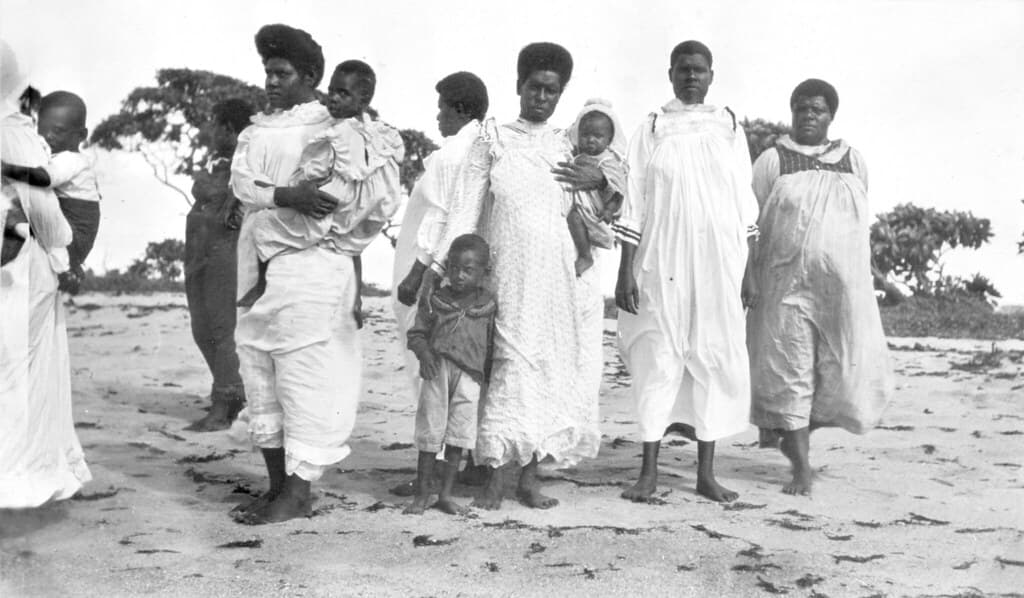
Saibai Island sits so close to Papua New Guinea that you can see the neighbouring coastline on clear days, a reminder that borders mean little to tides and migratory birds. The beach unfolds in muted tones—ochre sand, olive mangroves, water that shifts from milky jade to steel-grey depending on the cloud cover overhead. At low tide, the sea retreats hundreds of metres, revealing ribbed mudflats where herons pick their way across the exposed seabed.
“You're standing on Australia's border beach, where the nearest foreign country is closer than the nearest Australian city.”
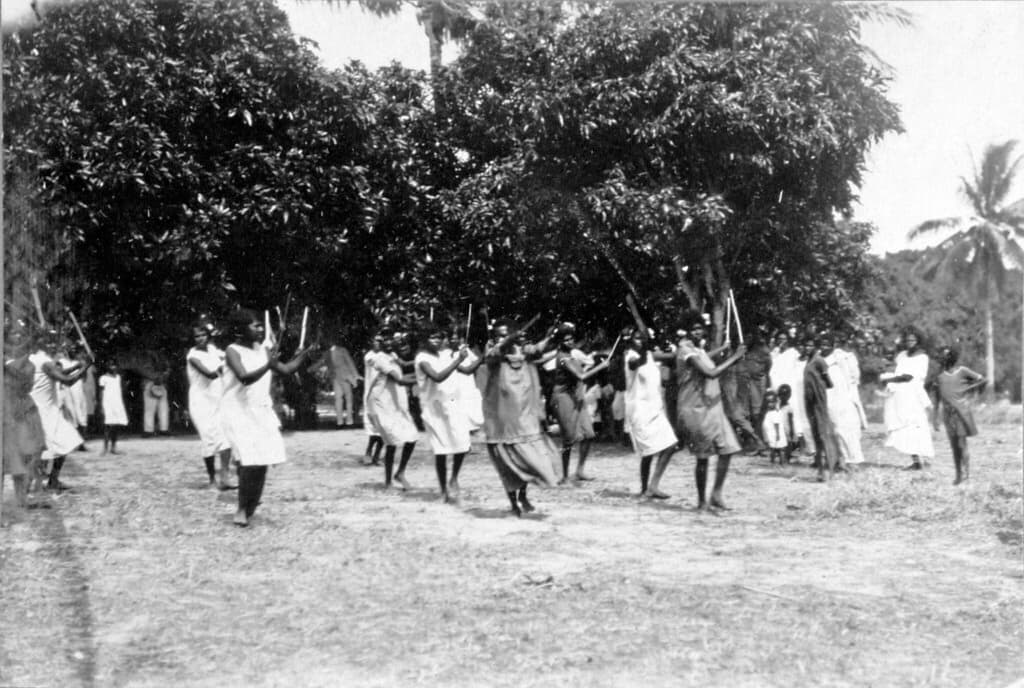 Credit: Flickr
Dancers, Poid, Torres Strait Island, June 1931
This is not a beach for plunging into waves. Instead, you time your visit to the water's return, when the shallow bay fills slowly and warmly, lapping at your ankles with barely a whisper. Local families arrive in the late afternoon, spreading mats beneath coastal she-oaks while children wade through the shallows. The air smells of salt and wet earth, occasionally cut by the sweetness of frangipani blooming near the shoreline.
You're visiting a Kaurareg and Saibailgal homeland, where the rhythm of the sea has governed daily life for thousands of years. There are no beach clubs or boardwalks here—just a sweep of sand where the Torres Strait laps at the edge of Australia, unhurried and unchanged. When the tide pulls back out, it leaves behind a silence broken only by the calls of Torres Strait pigeons settling into the trees.


