
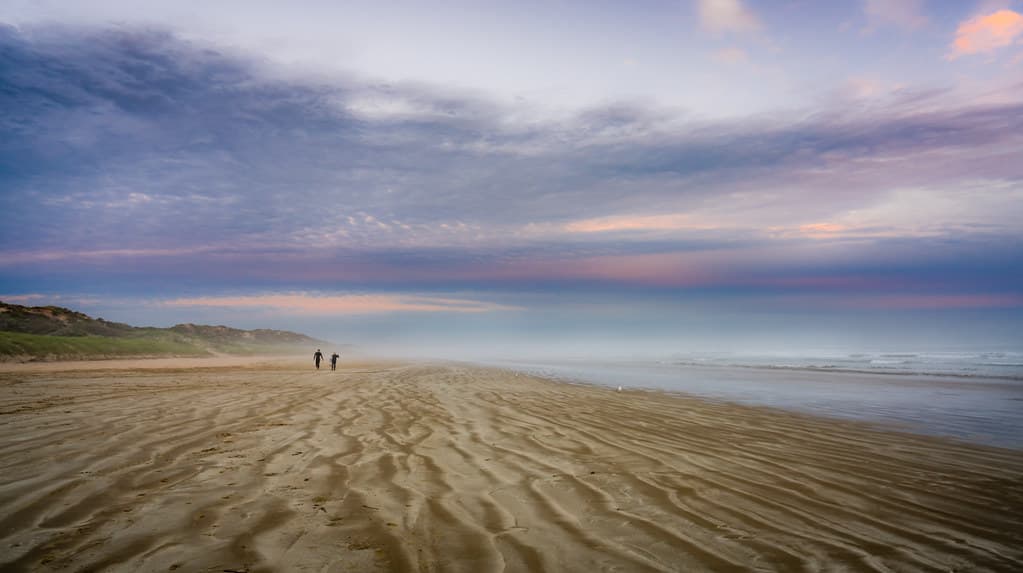
Stand at the water's edge and you're balancing on one of Australia's most volatile meeting points: the Murray River, after draining half a continent, squeezes through a narrow mouth to collide with the Southern Ocean. The resulting dynamics shape Goolwa Beach into a textured playground of sandbars, channels, and rips that shift with each tide. Surfers know this unpredictability well—the beach breaks can serve up hollow lefts one morning and wind-chopped mush by noon.
“This beach marks the living terminus of Australia's longest river, where river hydrology and ocean fury sculpt the shore in real time.”
 Credit: Flickr
Goolwa Beach Surfers
The sand itself is firm and pale, wide enough at low tide to accommodate a convoy of four-wheel-drives heading toward the Murray Mouth. Gulls work the foam line, stabbing for pipis while kite surfers harness the relentless westerlies that funnel down the river valley. The backdrop is all scrubby dunes and the skeletal silhouettes of she-oaks bending inland, their branches pruned by salt and wind.
Beyond the surf, the beach carries historical weight: this is the tail end of the Murray-Darling system, a river network that has sustained Indigenous Ngarrindjeri communities for millennia. The Mouth itself is a engineering flashpoint, dredged continuously to prevent siltation. Walk east and you'll reach the rock groynes near Goolwa Barrage; walk west and the strand unfurls toward the Coorong's lagoons, where pelicans glide over water the colour of tarnished silver.


