
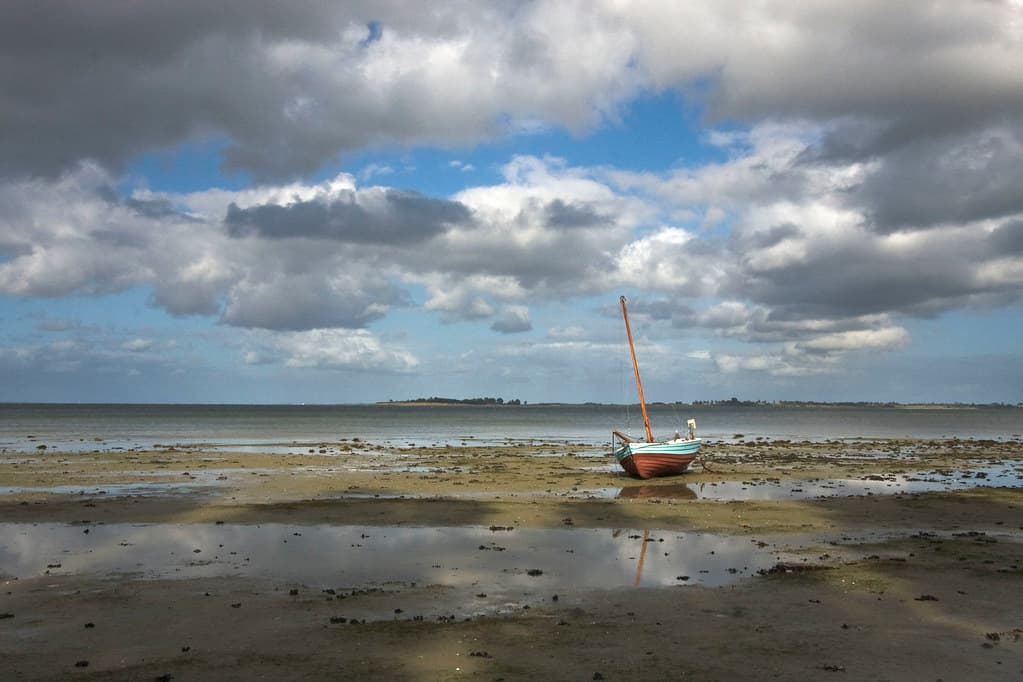
The road to Vitsø Strand threads through farmland dotted with half-timbered cottages, then opens suddenly onto a sweep of beach that feels more Swedish archipelago than Danish isle. Marram grass anchors the low dunes; shells collect in ridges along the tideline. The sand here is fine and cool underfoot, even on rare warm afternoons, and the water stays shallow for dozens of meters—ideal for wading but rarely swimmable beyond chest-deep.
“One of Denmark's last undeveloped west-facing beaches, where the Baltic's twilight show unfolds without a single building to interrupt the view.”
 Credit: Pexels
A dramatic view of waves crashing onto a sandy beach in Denmark under a blue sky.
This is Ærø stripped to essentials: no boardwalks, no snack bars, no lifeguard towers. You park in a gravel pull-off, cross a narrow footpath, and claim your stretch of shore. Late spring and early autumn bring the kindest weather—temperatures that coax locals out for post-work strolls but keep tour buses anchored in Ærøskøbing. The light here is the real attraction: low-angled and honey-gold, it gilds the distant Als coastline and turns the shallows opalescent.
Sunset transforms Vitsø into a minor amphitheater. Families spread blankets, thermoses appear, and everyone pivots west as the sky bleeds apricot, then plum. The sun sinks slowly here, unrushed as everything else on Ærø, and when it finally slips below the horizon, you'll understand why islanders guard this western edge so jealously.


