
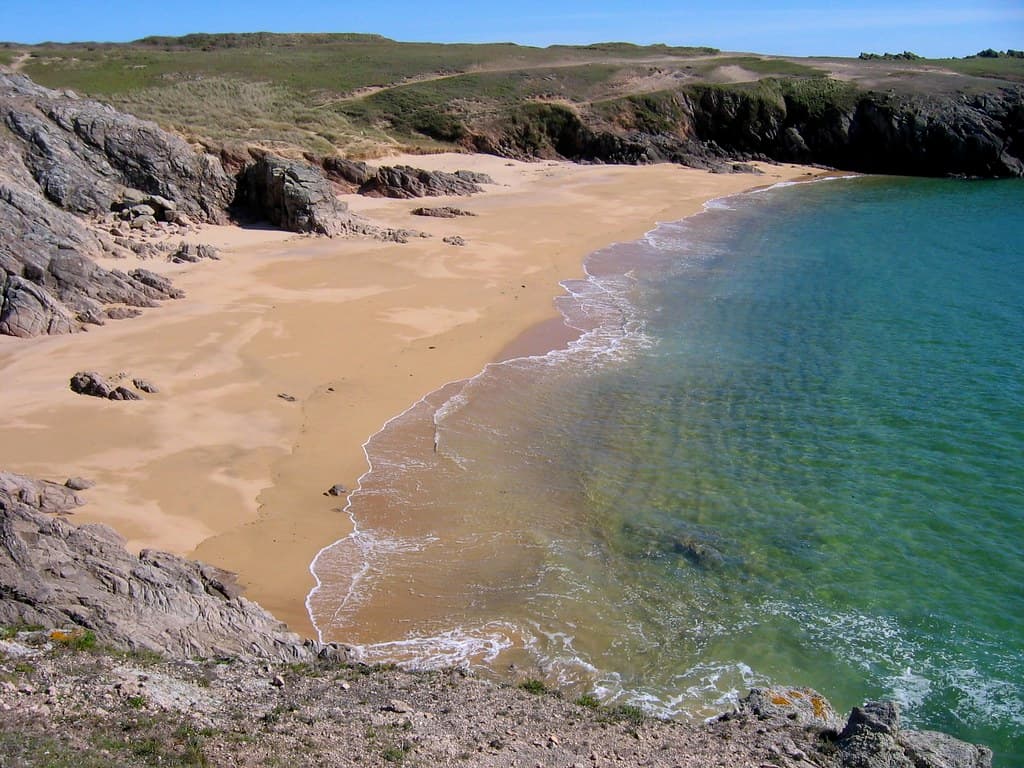
Fifteen minutes south of Houat's village harbor, past stone walls laced with pink valerian and the occasional grazing sheep, Treac'h Salus unfurls like a private postcard. The beach arcs between low rocky points, its sand so pale it throws back the afternoon light in a soft glare. At low tide, you can wade out a hundred meters, the water barely reaching your knees, warm enough by June that children dig moats and dams while their parents stretch out on striped towels brought over on the morning ferry.
“Treac'h Salus offers Houat's signature beauty in a sheltered, south-facing bowl that warms earlier and holds heat longer than the island's windswept northern shore.”
 Credit: Flickr
Plage de Treac'h Salus — photo by wanderer_photographer
Unlike the island's northern Grande Plage, which absorbs most day-trippers, Treac'h Salus draws a quieter crowd—islanders with wicker baskets, sailors who've anchored in the bay, the occasional camper from the municipal site tucked in the pines. The western headland blocks the prevailing wind, creating a microclimate that holds the day's warmth well into evening. Gulls wheel overhead, their cries mixing with the rhythmic slap of halyards from moored boats.
As the sun drops toward the Quiberon peninsula, the water shifts through a gradient of blues—from pale jade near shore to deep sapphire where the bay deepens. You'll want to linger past the last ferry, feet buried in cooling sand, watching the lighthouse on Hoëdic blink on across the sound. This is the Houat the day-trippers miss: unhurried, salt-stained, stubbornly itself.


