
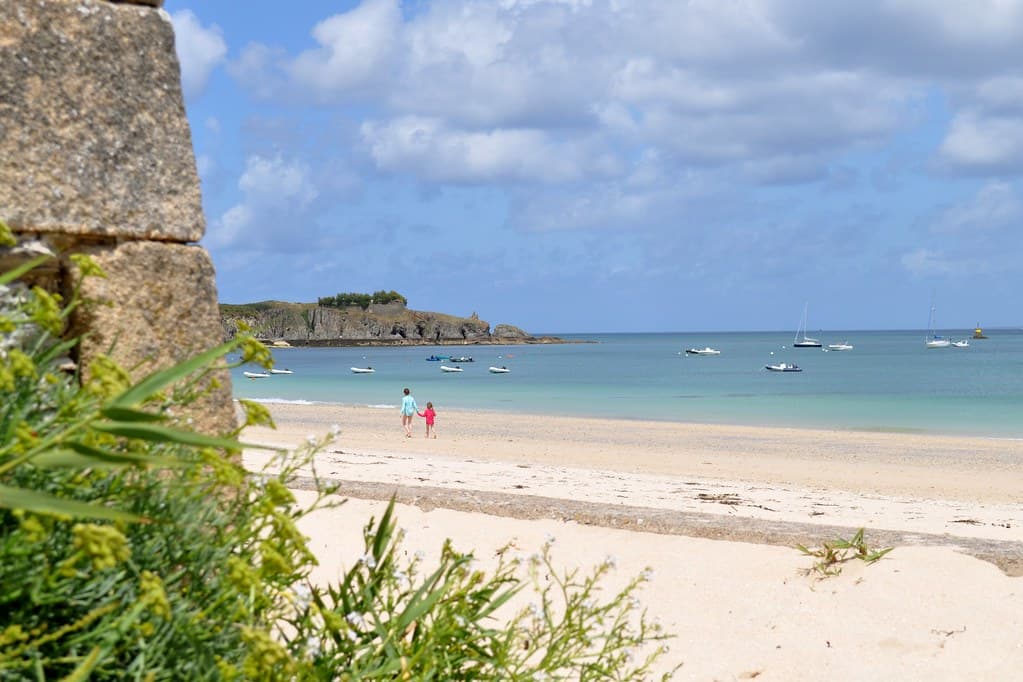
The ferry from Quiberon deposits you on Belle-Île, and a fifteen-minute cycle along the D190 brings you to Locmaria, where Plage des Grands Sables unfolds as the island's gentlest shoreline. Unlike the sheer cliffs that define most of Belle-Île's perimeter, this beach arcs outward in a convex crescent—geologists call it a tombolo—stretching nearly eight hundred meters of tawny, coarse-grained sand that crunches underfoot. The tidal range here exceeds four meters, so the beach you walk at noon becomes a memory by evening; locals set their beach umbrellas by consulting tide tables, not whim.
“Belle-Île's only convex beach allows you to watch both sunrise and sunset from the same stretch of sand.”
 Credit: Flickr
Almanach des Postes et des Télégraphes, registre 1887 - Une plage en Normandie
You'll share the sand with Breton families who've summered here for generations, their striped windbreaks staked against the westerlies that sweep across the bay. The water warms to eighteen degrees Celsius by July—bracingly cool but swimmable—and the gradual slope makes it forgiving for children testing their sea legs. Sailing dinghies tack back and forth beyond the swimming buoys, their white sails catching the afternoon light.
Stay past six o'clock and you'll understand why islanders call this the "double-sided beach." As the sun drops toward the Quiberon Peninsula, the convex geography lets you pivot from east-facing morning swims to west-facing aperitifs without moving your towel. The beach cafés serve galettes au sarrasin until eight, and the last ferry doesn't leave until nine-thirty, giving you time to watch the lighthouse on Pointe des Poulains blink to life across the darkening water.


