

The beach here feels provisional, as though the land and sea haven't quite agreed on terms. Dune grasses bend inland in the prevailing wind, their roots holding together loose sand that shifts with each storm, and you'll notice debris lines marking where winter waves reached—bleached driftwood, cuttlefish bones, tangles of dried Posidonia seagrass that smell faintly of iodine and decay.
“Geography's afterthought, this beach marks Molise's northern limit, overlooked by every regional tourism campaign and better for it.”
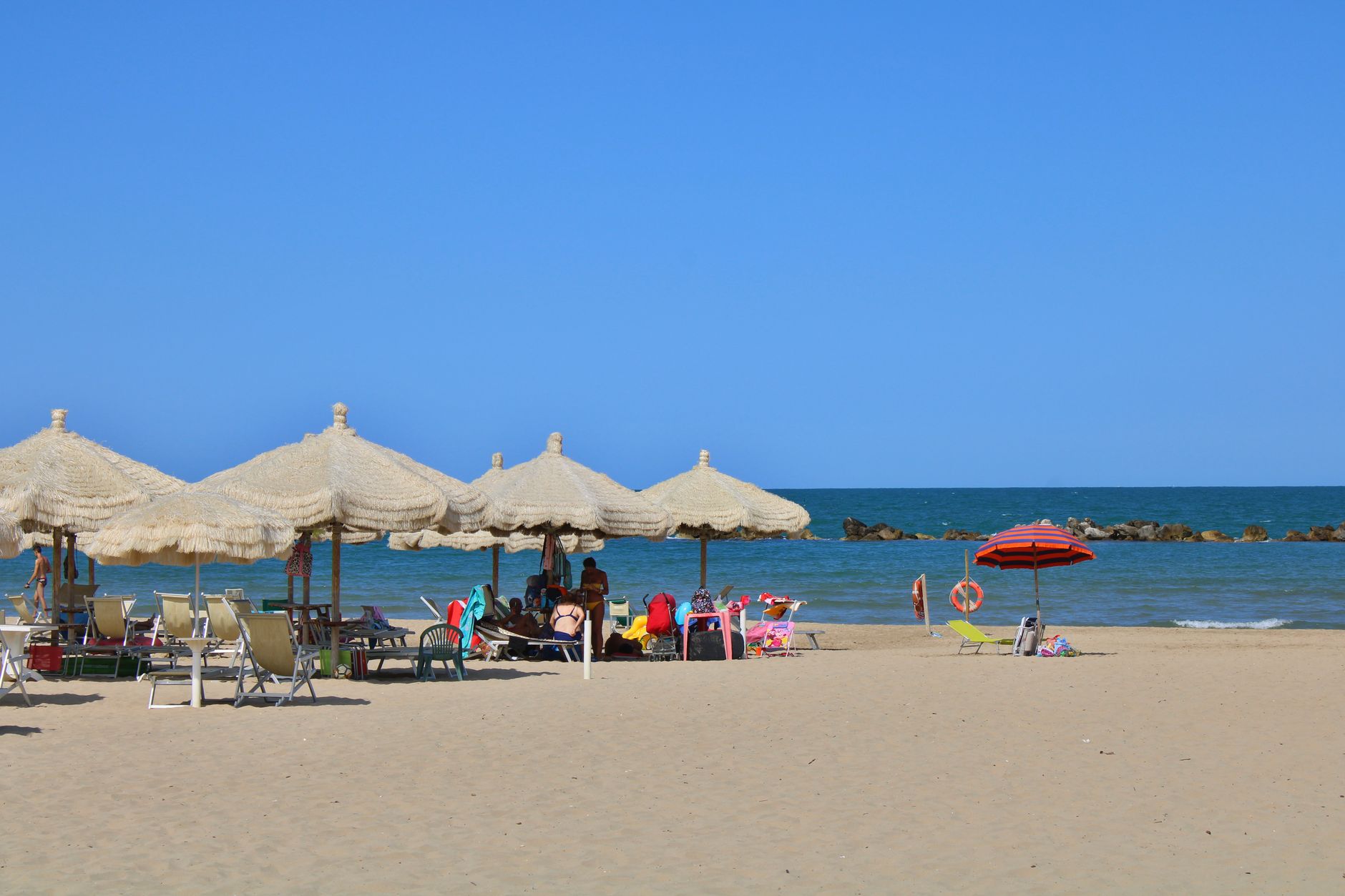 Credit: Pexels
Relax by the sea under umbrellas on Fossacesia beach, Abruzzo, Italy.
The sand itself is coarse, speckled with mica that catches sunlight like scattered sequins, and when you wade in, the bottom stays sandy rather than turning rocky. The water temperature runs a degree cooler than beaches farther south, fed by currents that sweep down from the Tremiti Islands, and you'll feel that coolness rise around your calves as you stand ankle-deep watching fishing boats motor past. By mid-afternoon the sun bakes the upper beach until heat shimmers off the sand, and you'll retreat to the scant shade of the dunes where wild thyme grows in silver-green clumps.
Sunsets here spread wide across the horizon—nothing blocks the view northward toward Vasto—and the light turns honey-colored, then rose, then violet as the sun drops. You might see a jogger or a local walking a dog, but mostly you'll have the dimming beach to yourself, listening to the Adriatic hiss against the shore and watching swallows hunt insects above the dune grass.


