
Counting the waves…
Counting the waves…
A refined fusion of water purity, environmental stability, and communal vibrancy for Blue Bay.
View MethodologyAnalyzed via live sensors and environmental data.
Wave height, wind, and atmospheric stability.
Live footfall and crowd balance metrics.
Community reviews and curated sentiment.
“The bay curves tight enough that you can see both headlands from the center of the beach, each arm of volcanic rock enclosing water that gradates through a dozen shades of blue. Sheep graze the slopes above,…”
Limited recent visitor reports — live OBI telemetry is your best guide for current conditions.
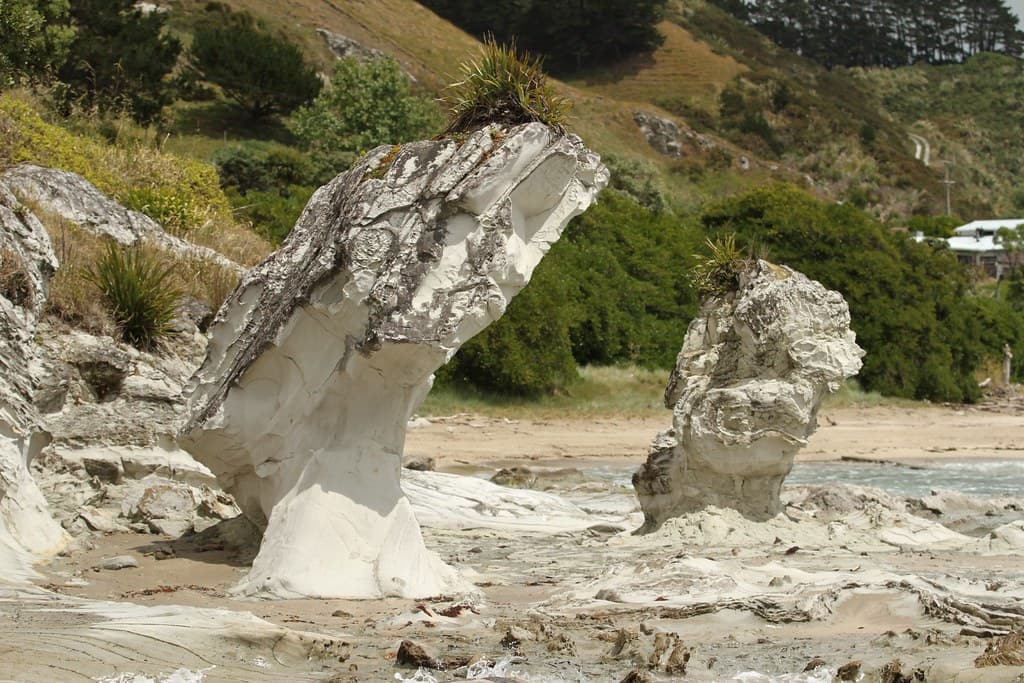
Access requires navigating a farm track—gates to open and close behind you, paddocks to cross where the neighbor's cattle barely acknowledge your passage. Blue Bay reveals itself suddenly as the track crests a low rise: a scoop of white sand perhaps a hundred meters across, tucked between headlands that shelter it from all but the most persistent swells. The water color justifies the name, shifting from pale turquoise where waves lap the beach to deep indigo where the bay opens to the Pacific.
The sand here stays genuinely white, composed of crushed shells and coral fragments rather than the iron-stained grains common on Hawke's Bay beaches. It squeaks underfoot when dry and compacts to a firm surface near the water, warm enough by midday that you'll hop-step to your towel. Rocky outcrops bookend the beach, their platforms accessible at low tide and colonized by green-lipped mussels and Neptune's necklace seaweed that pops satisfyingly under pressure. The clarity lets you watch fish darting between stones, and on calm days you can float on your back watching clouds without concern for currents or undertow.
Palm trees framing a sunset shore
Tropical island lagoon from above
Wade through changing water colors
Mussels and small fish visible
Shell-fragment beach retains heat
Prime Visitation
Best Weather|Less Crowds
Where it is
Blue Bay
Māhia, Hawke’s Bay, New Zealand
-39.132100°, 177.903500°
Weather
Loading…
Swell
—
Temp
Warm · Restorative
UV Index
Moderate
Wind
—
Tidal State
Last known
Max Sunlight
—
Ideal Shade
—
Jan - Dec (Peak)
Mar - Nov (Off-season)
Best Weather|Less Crowds
Select a category to load nearby places.
Unlock restaurants, luxury stays and curated maritime experiences within 2km
Blue Bay's cove formation typically offers more sheltered swimming conditions than open beaches, though caution is always necessary. There are no lifeguards on duty, so visitors swim entirely at their own risk. Check weather forecasts and ocean conditions before entering the water, as swells and currents can develop quickly on New Zealand's east coast. The bay is best suited for confident swimmers during calm conditions. Avoid swimming during storms, high winds, or when waves appear large. Always swim with a companion and stay within comfortable depth.
Blue Bay is most enjoyable during New Zealand's summer (December-March) when warm weather and calmer seas prevail. For fewer crowds and a more secluded experience, visit during autumn (April-May) or spring (October-November) when temperatures remain pleasant but visitor numbers drop. Weekdays offer greater solitude than weekends throughout the year. Morning visits provide the calmest conditions and best light for photography. The sheltered cove nature means Blue Bay can be pleasant even when other Māhia beaches are too windy for comfortable sunbathing.
Blue Bay is situated on the Māhia Peninsula in Hawke's Bay, roughly 90 minutes from Napier. Drive north on State Highway 2, then turn onto Māhia Peninsula Road following signs to Māhia. Finding Blue Bay requires local knowledge or GPS navigation, as it's not the main beach area. Roads are sealed but narrow in sections. Any standard vehicle can make the journey. Parking is very limited near the bay, and you may need to walk a short distance from where you park. Consider asking at Māhia township for specific directions.
Blue Bay itself has no commercial facilities, but nearby Māhia township offers limited accommodation including holiday homes, a motor camp, and bach rentals. Dining options in Māhia are basic, typically a small store and seasonal cafe. Most visitors rent self-contained properties and bring supplies from larger towns. Wairoa, approximately 30 minutes away, has motels, cafes, and restaurants with more variety. Napier and Gisborne offer extensive accommodation and dining but require longer drives. Booking accommodation well ahead during summer is essential, as Māhia has limited capacity.
Blue Bay distinguishes itself as a small, named cove that rewards explorers seeking beaches off the typical tourist path. Its compact size and hidden nature create an intimate setting ideal for couples or those desiring solitude. Unlike Māhia's main beach, Blue Bay feels like a personal discovery rather than a public destination. The scenic cove formation and clear waters on calm days justify its evocative name. Its relative obscurity means you're likely to enjoy the beach with minimal company, especially outside peak summer weekends, offering a genuine escape from busier coastal areas.
Photos