
Waverley Beach unfolds beneath cliffs that tell stories in strata—bands of sandstone, mudstone, and clay exposed where the coast crumbles gradually into the Tasman Sea. The beaches themselves carry the region's characteristic black sand, but here it mingles with clay runoff from the bluffs, creating patterns of charcoal and ochre along the tideline. This southern reach of Taranaki sees a fraction of the visitors who congregate around Surf Highway 45, leaving the coastline to locals, serious surfers chasing uncrowded breaks, and occasional travelers who've taken the detour south from the main route.
“Eroding sedimentary cliffs create a constantly evolving coastline of black sand, fossils, and solitary beach breaks far from tourist centres.”
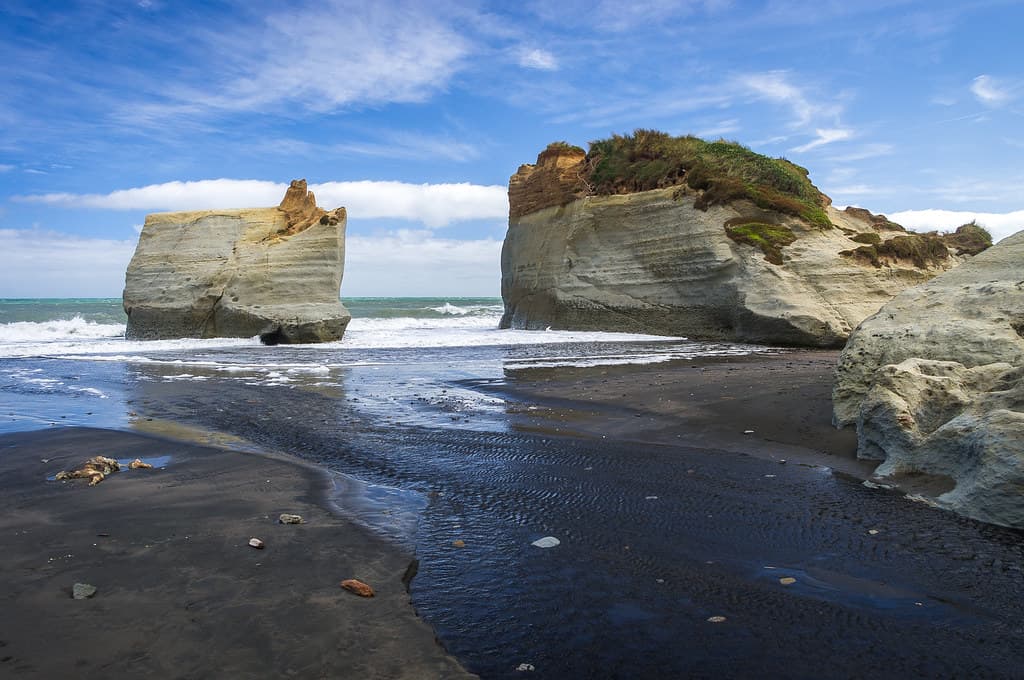 Credit: Flickr
Waverley Beach — photo by Vincent Lammin
The settlement of Waverley sits inland, connected to the beach by a gravel road that winds through farmland where sheep graze slopes dotted with cabbage trees. At the coast, you'll find a small cluster of holiday homes and a camping ground that fills modestly in summer but never approaches capacity. The beach stretches in both directions, backed by cliffs that provide shelter from prevailing westerlies on their lee side. Driftwood accumulates in massive piles where storm waves deposit entire trees, their roots still attached, worn smooth by months of tumbling.
Walking here requires watching the tides—some sections become impassable at high water when waves crash directly against cliff bases. But time it right and you can traverse kilometres of coastline, passing rock platforms where blue penguins sometimes nest and finding fossils weathering from the soft sediment. The isolation feels earned rather than accidental, a coastline that rewards the effort of getting slightly off the beaten track.


