Counting the waves…
Counting the waves…
A refined fusion of water purity, environmental stability, and communal vibrancy for Kumara Beach.
View MethodologyAnalyzed via live sensors and environmental data.
Wave height, wind, and atmospheric stability.
Live footfall and crowd balance metrics.
Community reviews and curated sentiment.
“The turnoff is easy to miss—a narrow gravel road slicing through farmland west of Kumara Junction. You follow it through paddocks where beef cattle graze, then suddenly the land drops away and the Tasman spreads before…”
Limited recent visitor reports — live OBI telemetry is your best guide for current conditions.
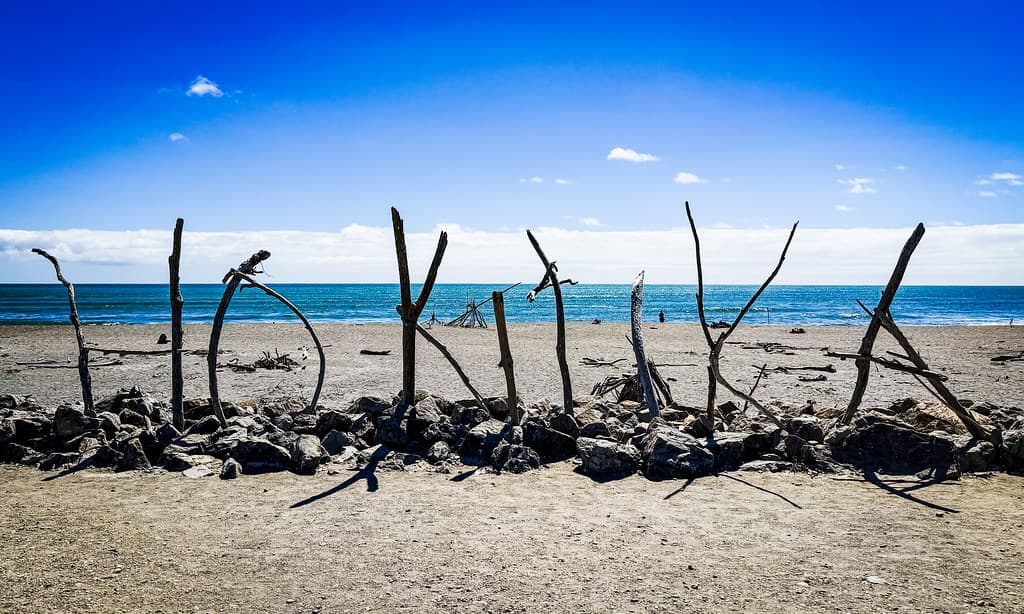
Kumara Beach stretches north toward the Taramakau River mouth and south past Dillmanstown in an unbroken line of compacted sand and rolling breakers. You park in the gravel lot where the road ends, stepping over wind-sculpted dunes held together by pingao and spinifex. The sand here is darker than the tourist beaches further south, laden with West Coast iron that stains your hands if you dig beneath the surface.
The Taratahi River cuts across the southern end, brown with tannins from the podocarp forests upstream. At low tide you can wade across where it spreads shallow over the sand, though the current picks up quickly when the tide turns. Driftwood accumulates in massive jams where the river meets the beach, creating sculptures twenty feet high—entire trees with root systems intact, whitened by salt and polished by sand.
Crashing wave at sunset on the shoreline
Miles of undeveloped coastline
River-mouth timber sculptures
Consistent beach break waves
Prime Visitation
Less Crowds
Where it is
Kumara Beach
Kumara Junction, West Coast, New Zealand
-42.608500°, 171.075700°
Weather
Loading…
Swell
—
Temp
Warm · Restorative
UV Index
Moderate
Wind
—
Tidal State
Last known
Max Sunlight
—
Ideal Shade
—
Jan - Dec (Peak)
Mar - Nov (Off-season)
Historical data suggests peak visibility and stable sea temperatures occur during the prime visitation window.
Select a category to load nearby places.
Unlock restaurants, luxury stays and curated maritime experiences within 2km
Swimming at Kumara Beach is not recommended for most visitors. The beach faces the open Tasman Sea with powerful surf, strong rip currents, and unpredictable conditions. There are no lifeguards, facilities, or rescue services. The undeveloped nature means you're largely on your own. The beach is better suited for walking, beachcombing, and scenery rather than water activities. If you do wade, stay in very shallow water, never turn your back on the waves, and supervise children constantly. Water temperatures are cold throughout the year.
Kumara Beach sees few visitors year-round due to its undeveloped, off-the-beaten-path location, so crowds are rarely an issue. Weekdays are quieter than weekends when locals may visit. Autumn (March-May) and spring (September-November) offer mild conditions with minimal visitors. The West Coast's high rainfall means weather is unpredictable in any season. Early mornings and late afternoons provide the best light for photography and sunset viewing. Winter months offer solitude and dramatic storm-watching if you don't mind wet, windy conditions.
Access to Kumara Beach involves driving from Kumara Junction toward the coast on local roads that may be unsealed or gravel. The exact route can vary, and signage may be limited, so local inquiry or GPS is recommended. The road conditions can deteriorate in wet weather, typical of the West Coast. A vehicle with reasonable clearance is advisable. The beach is not heavily promoted or developed, so prepare for basic or minimal parking facilities. Check locally about current road conditions before setting out.
The small settlement of Kumara, a few kilometers away, has very limited services—possibly a pub or basic store. Greymouth, approximately 30km north, is the nearest town with full services including supermarkets, restaurants, cafés, and fuel. Accommodation options in Greymouth range from motels to hotels and backpackers. Hokitika, about 40km south, also offers dining and lodging. There are no facilities at Kumara Beach itself, so bring all necessary supplies including food, water, and emergency items.
Kumara Beach's main appeal is its wild, untouched character and sense of remoteness. The long, undeveloped strand offers solitude and authentic West Coast scenery without tourist infrastructure or crowds. It's ideal for photographers seeking dramatic coastal landscapes, sunset chasers, and travelers who appreciate unspoiled natural environments. The beach provides excellent beachcombing, driftwood collecting, and peaceful walking. Its lack of development means you experience the Tasman coastline much as it has existed for centuries, offering a stark contrast to more commercialized destinations.
Photos