
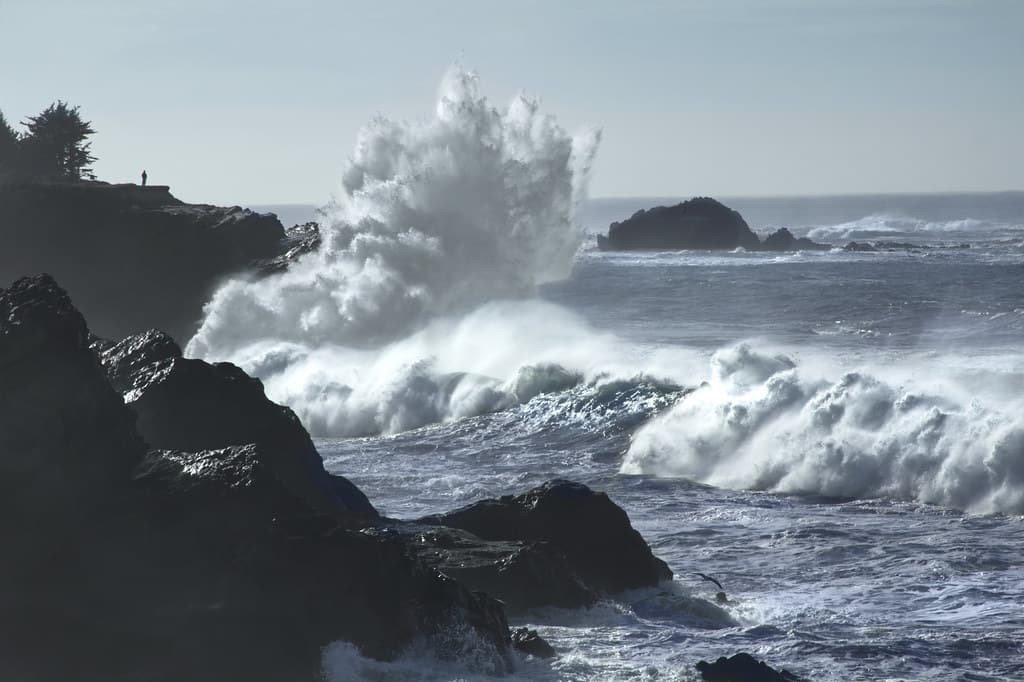
Shore Acres occupies a peculiar place in Oregon's coastal geography: it's not really a beach at all, but rather a rocky shoreline where the ocean performs daily acts of spectacular violence against sedimentary cliffs. The sandstone shelves here glow in shades of ochre and sienna, carved into swooping curves and deep fissures by millennia of wave action. On winter days when southwesterly swells collide with incoming tides, plumes of white water explode upward, drenching the observation platforms and leaving you tasting salt on your lips from a hundred yards away.
“The state park measures wave heights during winter storms, which routinely exceed forty feet against the observation deck—among the coast's most accessible displays of raw ocean power.”
 Credit: Flickr
King tides and big waves, Shore Acres, Oregon coast
The site sits within Shore Acres State Park, the former estate of timber baron Louis J. Simpson, who transformed these wind-battered headlands into formal gardens in the early 1900s. Those gardens still bloom—incongruously manicured beds of dahlias and Japanese maples thriving in the coastal fog—but most visitors come for the geological drama below. You'll want to time your visit with high tide and stormy weather, when the Pacific shows its full strength against the rock.
Low tide reveals a different world: tide pools cradle purple sea stars and anemones, while harbor seals haul out on offshore rocks. The sandstone formations create natural amphitheaters where the ocean's rhythm becomes almost hypnotic, each wave carving infinitesimally deeper into stone that records millions of years in horizontal bands of sediment.


