
The ciénaga—a coastal lagoon fed by seasonal streams and tidal pulses—empties here through a throat maybe thirty meters wide, its current reversing with the moon. At flood tide the Caribbean pours in, turning the lagoon glassy and raising the water temperature five degrees; at ebb, the outflow carves ripples in the sand and carries leaf litter seaward in rafts. You stand at the divide, one foot in lagoon-warm shallows, the other in the cooler surf, and watch needlefish arrow through the mixing zone.
“One of the few Caribbean lagoon mouths you can stand inside, feeling the ocean's pulse flood past you twice daily, reversing the current beneath your feet.”
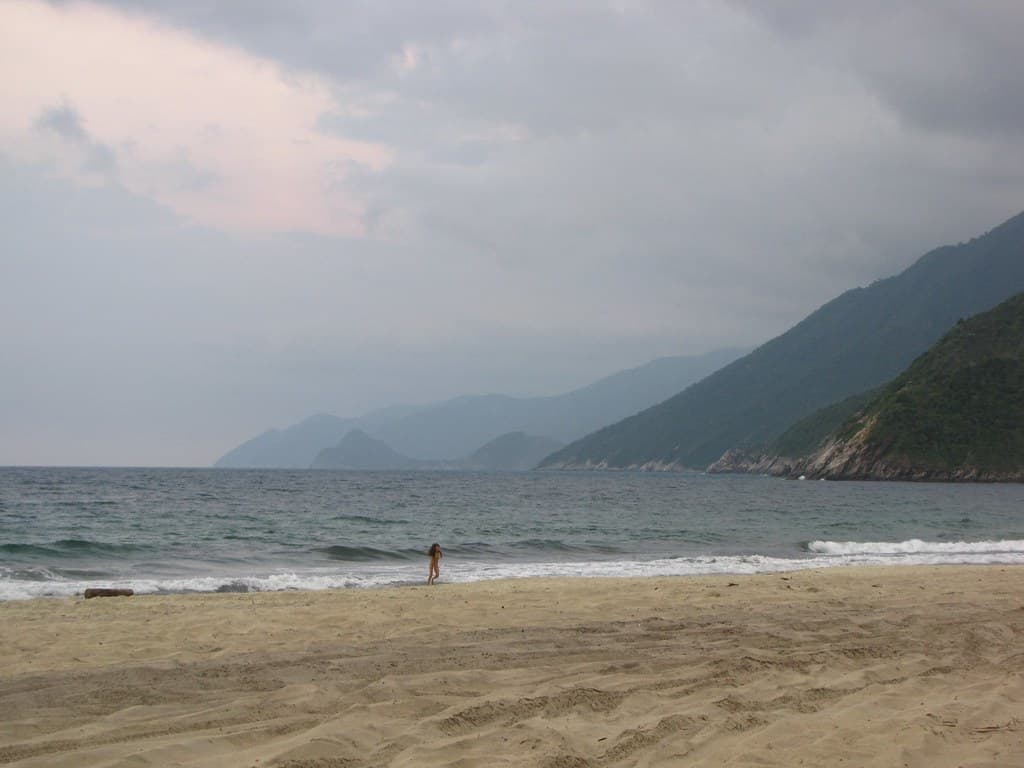 Credit: Flickr
Playa Boca de La Ciénaga — photo by Cristóbal Alvarado Minic
Mangroves guard the eastern margin in a dense tangle of prop roots and pneumatophores, their canopy alive with boat-tailed grackles and the occasional mangrove warbler. The western spit is bare sand, scoured clean by tidal flux, dotted with bleached conch shells and the occasional Portuguese man o' war stranded by the outgoing current. Frigatebirds wheel overhead, their scissor tails black slashes against cumulus, and pelicans roost on half-submerged snags that mark the lagoon's drowned former shoreline.
Sunset here feels amphibious: the sky's reflection doubles in the lagoon's mirror plane, and the horizon dissolves into uncertain geometry. Fishermen pole dugouts through the shallows, their silhouettes stretched long, checking gill nets set at the channel's edge. You hear the ocean before you see it—a low, rhythmic exhale—then the first wavelets lap your ankles, salinity spiking on your tongue, the transition from stillness to motion measured in footsteps.


