
Cape Bowling Green juts into the Pacific like a geographer's dare—thirty kilometers of sand and wind-sculpted dune that separates Cleveland Bay from the open Coral Sea. You stand on the narrow spine and feel the weird vertigo of too much horizon: saltwater to your left, saltwater to your right, and beneath your feet a ribbon of pale sand so slender you could skip a stone across it. The wind here doesn't gust; it presses, steady and warm, carrying the salt-bright smell of exposed reef and sun-baked mudflat.
“It's Australia's longest sand spit, a rare geomorphic feature where you walk a tightrope between two seas.”
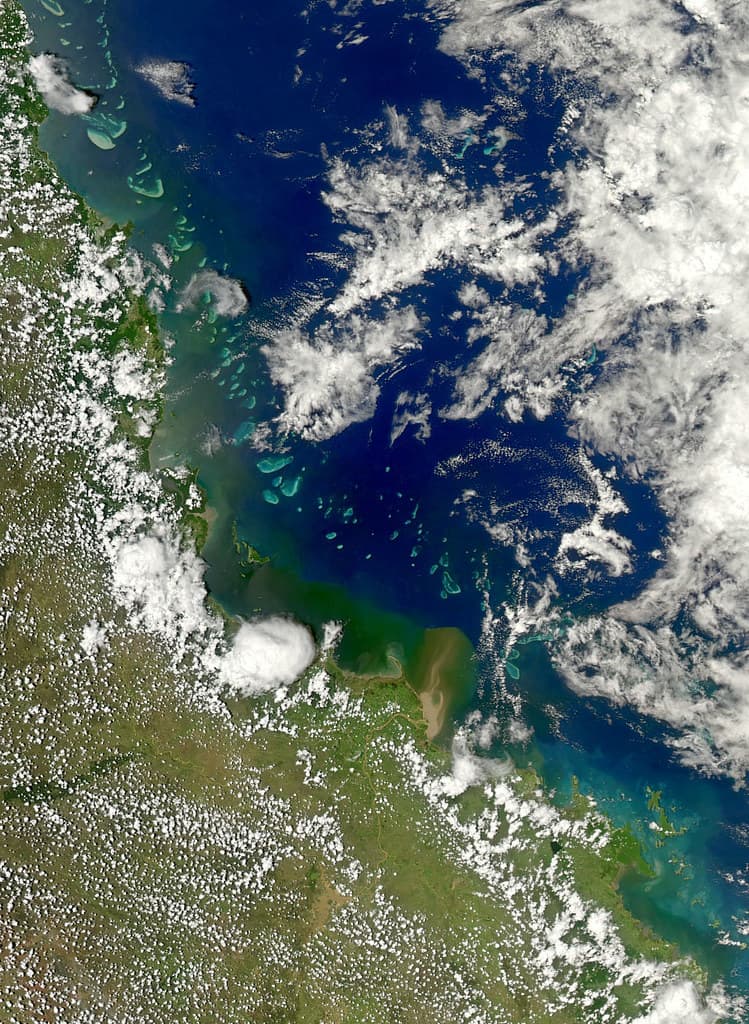 Credit: Flickr
Heavy Sediment along the Queensland Coast
This is Bowling Green Bay National Park's most dramatic feature, accessible by four-wheel-drive and patience. The track rattles through melaleuca woodland and past tidal creeks before depositing you at the base of the spit. Walk north and the beach opens up—empty, often entirely yours, punctuated only by the skeletal trunks of trees claimed by the advancing sea. Shorebirds work the tideline in quick, mechanical bursts.
Come for sunset and the spit glows apricot, the water on both flanks turning molten. The light here is equatorial and unfiltered, the kind that makes you squint and reach for your hat, then forget both because the view has swallowed you whole. There's no café, no lifeguard, no bollards marking where to stand. Just thirty kilometers of sand doing what sand does best: existing, shifting, refusing to be anything other than itself.


