Counting the waves…
Counting the waves…
A refined fusion of water purity, environmental stability, and communal vibrancy for Cape Bowling Green.
View MethodologyAnalyzed via live sensors and environmental data.
Wave height, wind, and atmospheric stability.
Live footfall and crowd balance metrics.
Community reviews and curated sentiment.
“You'll drive two hours south of Townsville, then turn onto gravel that leads to a seemingly endless ribbon of sand curving into blue water. The spit narrows to just meters in places, ocean on one side, gulf on the…”
Limited recent visitor reports — live OBI telemetry is your best guide for current conditions.
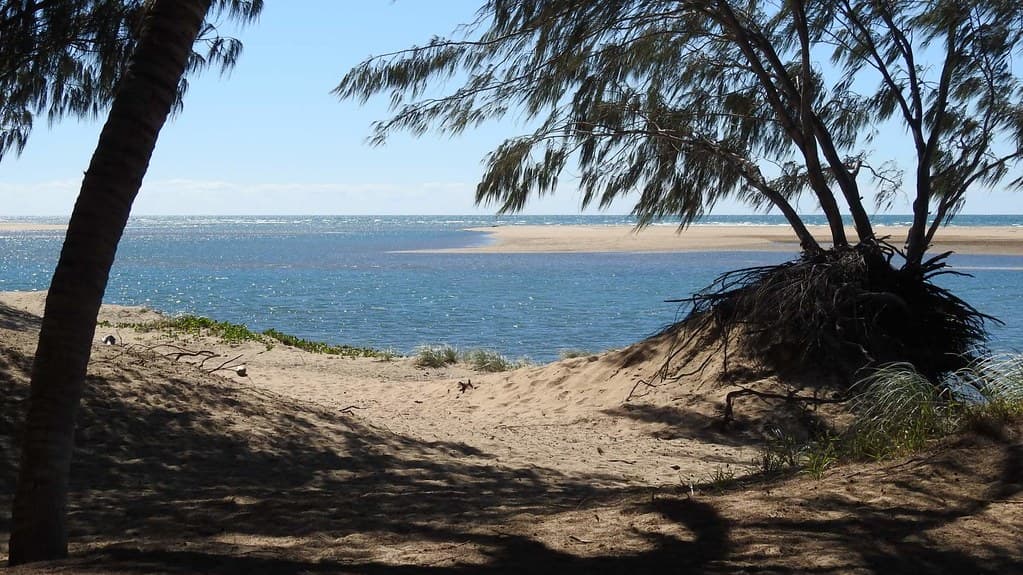
Cape Bowling Green juts into the Pacific like a geographer's dare—thirty kilometers of sand and wind-sculpted dune that separates Cleveland Bay from the open Coral Sea. You stand on the narrow spine and feel the weird vertigo of too much horizon: saltwater to your left, saltwater to your right, and beneath your feet a ribbon of pale sand so slender you could skip a stone across it. The wind here doesn't gust; it presses, steady and warm, carrying the salt-bright smell of exposed reef and sun-baked mudflat.
This is Bowling Green Bay National Park's most dramatic feature, accessible by four-wheel-drive and patience. The track rattles through melaleuca woodland and past tidal creeks before depositing you at the base of the spit. Walk north and the beach opens up—empty, often entirely yours, punctuated only by the skeletal trunks of trees claimed by the advancing sea. Shorebirds work the tideline in quick, mechanical bursts.
Endless sand ridge between seas
Exposed flats mirror the sky
Coral Sea light turns amber
Where it is
Cape Bowling Green
Alva, Queensland, Australia
-19.358950°, 147.448980°
Weather
Loading…
Swell
—
Temp
Warm · Restorative
UV Index
Moderate
Wind
—
Tidal State
Last known
Max Sunlight
—
Ideal Shade
—
May - Sep (Peak)
Jan - Dec (Off-season)
Historical data suggests peak visibility and stable sea temperatures occur during the prime visitation window.
Select a category to load nearby places.
Unlock restaurants, luxury stays and curated maritime experiences within 2km
Swimming conditions at Cape Bowling Green require caution. The beach is remote and unpatrolled, with no lifeguard services. Strong currents and tides can be present along the sand spit. Marine stingers (box jellyfish and irukandji) occur in tropical North Queensland waters, particularly October through May, making stinger suits essential during these months. Crocodiles inhabit coastal areas of North Queensland, so always observe warning signs. The shallow waters and long sandbars can create unpredictable conditions. This beach is better suited for wading and beach walking than swimming.
Cape Bowling Green is accessible year-round, with each season offering different experiences. The dry season (May to October) provides the most comfortable weather with lower humidity, minimal rainfall, and reduced marine stinger risk. These cooler months are ideal for beach walks and exploring the sand spit. The wet season (November to April) brings higher temperatures, humidity, and afternoon storms, but also spectacular cloud formations for photography. Sunset viewing is excellent throughout the year. Early mornings and late afternoons offer the best conditions for avoiding midday heat.
Cape Bowling Green is located approximately 40 kilometres southeast of Townsville and 10 kilometres from the small township of Alva. Access is via Cape Bowling Green Road off the Bruce Highway. The final stretch involves unsealed roads that may require a 4WD vehicle, especially after rain. Limited informal parking is available near the beach access points. The remote location means facilities are minimal. Plan for a day trip from Townsville or nearby centres, and check road conditions before travelling, particularly during the wet season.
Cape Bowling Green has no food outlets, amenities, or accommodation directly at the beach. The nearby township of Alva offers very limited services. Visitors should bring all necessary supplies, including food, water, and sun protection. The closest town with comprehensive services, including restaurants, supermarkets, and accommodation, is Townsville, approximately 40 kilometres away. Ayr, about 30 kilometres south, also offers basic services. This is a remote beach experience requiring self-sufficiency. Always pack out all rubbish as there are no bins on site.
Cape Bowling Green boasts Australia's longest natural sand spit, stretching approximately 13 kilometres into Bowling Green Bay. This remarkable geomorphic feature was formed by longshore drift and ocean currents depositing sand over thousands of years. The narrow peninsula creates unique landscapes where you can see water on both sides. It's a significant site for coastal geomorphology and offers exceptional opportunities for photography, particularly at sunset. The remote, undeveloped nature means you'll often have this natural wonder virtually to yourself, providing a true wilderness beach experience.