
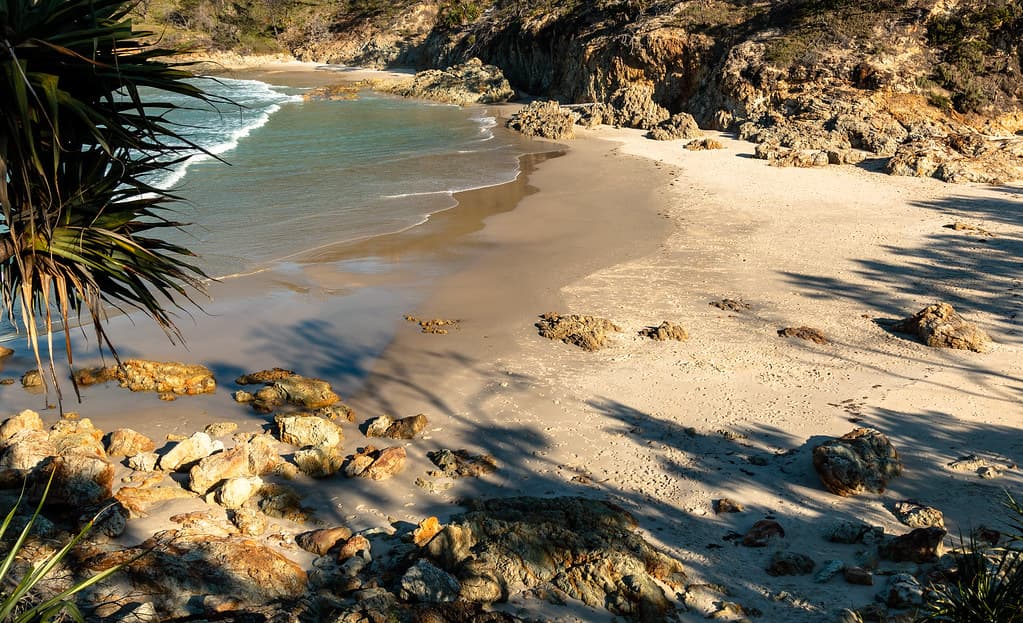
The tender cuts its engine fifty meters offshore, and you wade through bathwater shallows onto sand so fine it squeaks underfoot. Honeymoon Bay arcs in a tight crescent beneath Cape Moreton's basalt headland, sheltered from the Coral Sea's prevailing swells by reef fingers that turn incoming waves into frothy riffles. She-oaks whisper behind the high-tide line, their needles carpeting the narrow strip where wallabies bound at dusk. No roads reach this cove—just a network of sand tracks that dead-end kilometers south, making every visitor a passenger, every arrival a small act of commitment.
“The only beach in Queensland's protected marine park where you can snorkel volcanic boulders beneath an active nineteenth-century lighthouse.”
 Credit: Flickr
Honeymoon Bay at Moreton Island
The lighthouse keeper's cottage still crowns the cape above, its whitewashed walls visible through breaks in the coastal scrub. Early mornings, you might spot researchers tagging loggerheads that nest here November through February, their flippers carving temporary highways across virgin sand. The snorkeling skirts rocky outcrops thick with sergeant majors and wrasse; bring booties, because the entry is all chunky volcanic rubble disguised by knee-deep water.
By midafternoon, the nor'easter picks up and the bay's glassy morning calm fractures into wavelets. Most day-trippers have motored back to Tangalooma by then, leaving you with oystercatchers working the tide line and the rhythmic thunk of pandanus fruit dropping onto sun-warmed sand. Pack everything in; the island's pack-it-out ethos isn't a suggestion, and the nearest rubbish bin floats twenty nautical miles west in Moreton Bay.


