
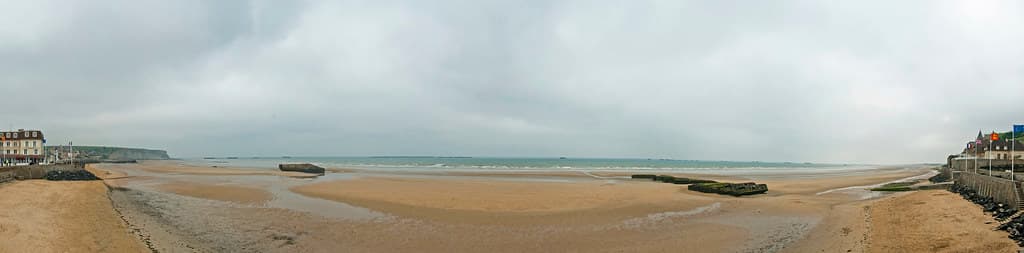
The narrow road through Tracy-sur-Mer winds past stone farmhouses before dropping you onto a crescent of sand and shingle that curves westward toward Arromanches. No plaques interrupt the strand itself—just a concrete pillbox half-buried in marram grass and the faint tracery of rust on tide-washed rebar. The beach smells of kelp and diesel from the fishing boats moored offshore, and in late afternoon the chalk cliffs turn butter-gold, then rose.
“This Gold Beach sector delivers D-Day history without interpretation boards, letting tide and light do the storytelling.”
 Credit: Flickr
Plage du débarquement
You'll share the foreshore with Norman retirees walking spaniels and the occasional historian running fingers over pocked blockhouse walls. Low tide exposes ribbed sand that holds boot-prints for hours, and children in wellies poke at hermit crabs in tidal pools edged with bladderwrack. The water stays cold even in July—plan on sixteen degrees Celsius and a breath-stealing plunge.
Come near sunset when the beach empties entirely. The light slants low across the Channel, gilding the wave-tops and throwing long shadows from the anti-tank obstacles still embedded in the lower beach. Oystercatchers call from the waterline. You'll understand why locals guard this stretch: it asks nothing of you but attention, and repays it with a silence that feels earned.


