
Counting the waves…
Counting the waves…
A refined fusion of water purity, environmental stability, and communal vibrancy for Plage des Grands Sables.
View MethodologyAnalyzed via live sensors and environmental data.
Wave height, wind, and atmospheric stability.
Live footfall and crowd balance metrics.
Community reviews and curated sentiment.
“You step off the ferry onto an island where pine forests meet a crescent that bends the wrong way. Plage des Grands Sables reshapes itself each season, its russet-tinted grains crunching underfoot as fishing boats round…”
Limited recent visitor reports — live OBI telemetry is your best guide for current conditions.
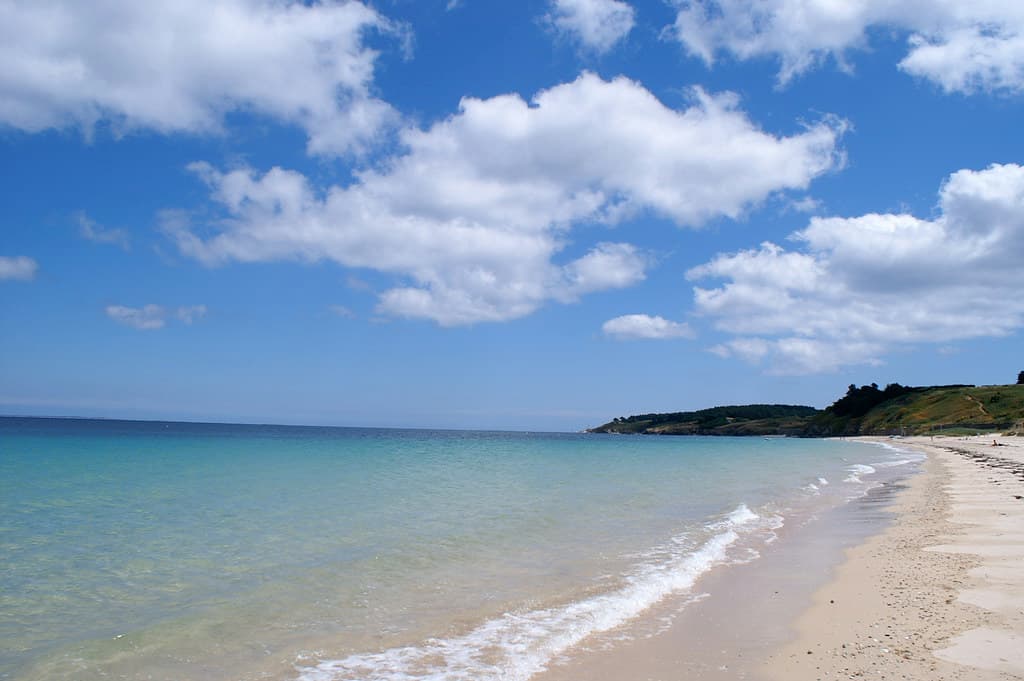
The beach does something no other strand in Europe manages: it curves outward, a convex arc that has migrated sixty meters eastward since the 1930s. You notice the garnet first—tiny ruby fragments mixed into the blonde sand, remnants of the island's mining past. The beach stretches four hundred meters between rocky points, shallow enough that children wade out thirty paces before the water reaches their waists, while kitesurfers skim the deeper channel beyond.
You reach Groix by ferry from Lorient, a forty-five-minute crossing that deposits you in Port-Tudy. Rent a bicycle or catch the island shuttle; the beach lies on the southeastern shore, sheltered by maritime pines that lean permanently eastward from prevailing winds. In summer, food trucks park behind the dunes selling galettes and cidre. In October, you might share the sand with a dozen locals and their dogs, watching the beach reclaim yet another meter from the sea.
Warm pools at low tide
Ruby grains catch last light
Rock formations beyond the point
Where it is
Plage des Grands Sables
Groix, Morbihan, France
47.638300°, -3.373000°
Weather
Loading…
Swell
—
Temp
Warm · Restorative
UV Index
Moderate
Wind
—
Tidal State
Last known
Max Sunlight
—
Ideal Shade
—
May - Sep (Peak)
Jan - Dec (Off-season)
Historical data suggests peak visibility and stable sea temperatures occur during the prime visitation window.
Select a category to load nearby places.
Unlock restaurants, luxury stays and curated maritime experiences within 2km
Plage des Grands Sables is generally safe for swimming and very family-friendly, with shallow waters and gentle slopes ideal for children. The beach is supervised during summer months (typically July-August). However, currents can vary depending on tides and weather conditions, so always check local flags and warnings. The beach's unique characteristic is that it's convex and shifts position over time due to ocean currents, which can affect conditions. Outside peak season, no lifeguards are present, so exercise caution and swim only in calm conditions.
While Plage des Grands Sables can be visited year-round, June through September offers the warmest weather and calmest seas, with temperatures reaching 20-25°C. July and August are peak season with full amenities but larger crowds. Spring (May-June) and early autumn (September) provide milder weather, fewer visitors, and still-pleasant swimming conditions. The beach faces south, making it excellent for sunset viewing throughout the year. Winter visits offer dramatic scenery and solitude, though swimming is only for the brave, and island ferry schedules are reduced.
Plage des Grands Sables is only accessible by boat, as it's located on Groix Island. Take a ferry from Lorient (Port de Peche) to Port Tudy on Groix; crossings run year-round, taking approximately 45 minutes. From Port Tudy, the beach is about 5km away—rent a bike (recommended), take a taxi, or use the seasonal island bus. Limited parking exists near the beach access path. For mainland parking, use designated lots near Lorient ferry terminal. Book ferry tickets in advance during summer, as capacity is limited.
Plage des Grands Sables has basic facilities including seasonal beach showers and toilets. A popular beachside crêperie operates during summer months, serving snacks and refreshments. For more dining options and shops, head to Port Tudy or Groix's main village (Bourg), both offering restaurants, cafés, and grocery stores. Accommodation options on the island include hotels, vacation rentals, and campsites, though booking well ahead for summer is essential. Many visitors prefer staying in Lorient on the mainland for wider choices, then day-tripping to the beach.
Plage des Grands Sables is famous as one of Europe's few convex beaches and is known for literally moving position. Ocean currents cause the beach's sand to shift eastward along the coast over time—it has migrated several hundred metres over recent decades. This unique geological phenomenon, combined with its distinctive curved shape bulging outward into the sea, makes it a remarkable natural feature. The beach's composition of fine, shell-rich sand also contributes to its mobility. This constant transformation means the beach's exact shape and extent vary from year to year.
Photos