
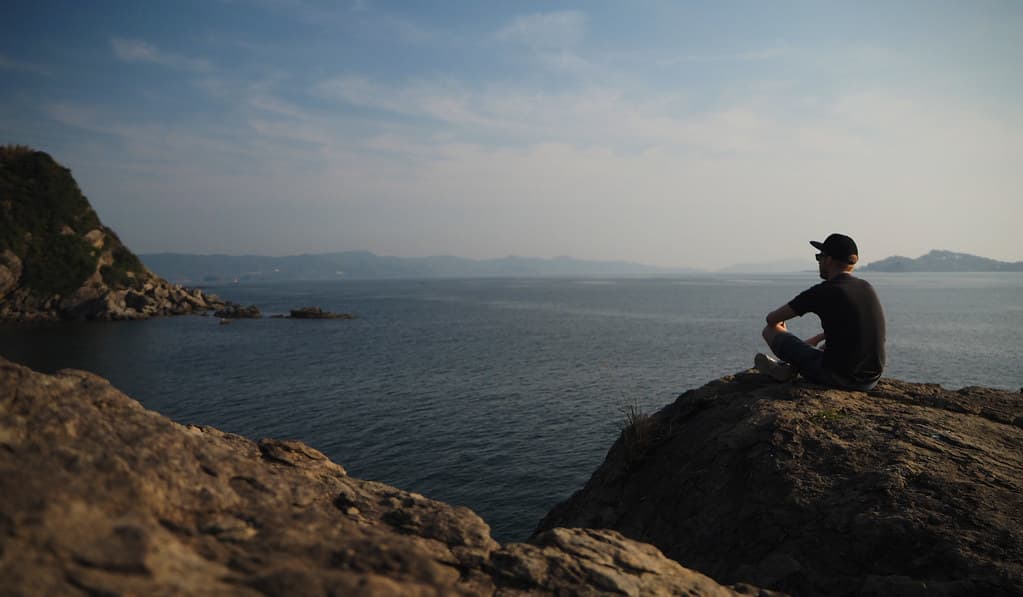
The name means "thousand tatami mats," and standing on this expanse of horizontal basalt, you understand why. Senjojiki isn't a beach in the conventional sense—no soft sand, no gentle slope into water. Instead, the coastline here splinters into wide, flat ledges of volcanic rock, each shelf scored with parallel grooves that channel seawater into shallow tidal pools. The platforms extend seaward in steps, and you pick your way across them carefully, feeling the rough grain beneath your shoes, hearing the hollow slap of waves against stone.
“A wave-carved basalt terrace that transforms sunset into a study of light on ancient stone.”
 Credit: Flickr
Iojima Island / Senjojiki Beach
Winter storms along the Tsugaru coast sculpted this terrace over millennia, waves gnawing at softer layers while harder basalt resisted, creating a striated landscape that shifts from charcoal to rust depending on the light. Locals have walked these ledges for generations, harvesting seaweed, fishing from the edges, watching typhoons batter the rocks into new shapes. You'll see families crouched by tide pools, elderly fishermen casting lines, photographers tripod-deep in crevices waiting for the sun to drop.
Evening is when Senjojiki earns its reputation. The Sea of Japan swallows the sun in shades of persimmon and plum, light streaking across wet rock, turning every ridge into a golden thread. You stand on ancient lava, salt wind in your face, watching day collapse into the horizon. This is the Aomori coast stripped to its elements—stone, water, sky—and it asks nothing of you but attention.


