
You're standing as far north as Japan allows, where the 45th parallel slices through a crescent of charcoal sand and the Russian island of Sakhalin hovers like a mirage eleven miles offshore. Noshappu Beach stretches beneath Cape Noshappu's lighthouse, a thin ribbon where the Soya Strait churns cold and restless even in August. The water temperature rarely climbs above sixty degrees, and most visitors keep their shoes on, drawn instead by what happens behind them: the sun dropping behind the ridgeline of Mount Rishiri, sixty miles southwest, its volcanic cone cutting the sky into geometric planes of tangerine and plum.
“Japan's northernmost beach offers dual horizons—Sakhalin to the west, Rishiri's volcanic peak to the south—where the sun sets over land instead of sea.”
 Credit: Flickr
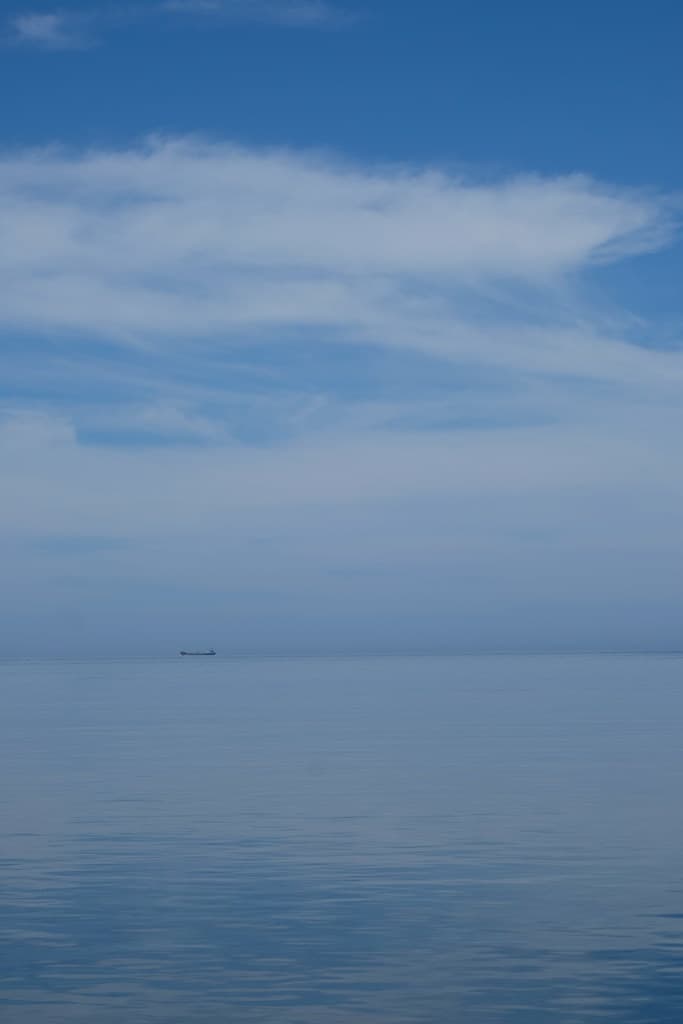
A boat on the Sea of Okhotsk
The beach operates on a different clock than Okinawa or Shonan. In June the sun doesn't set until seven-thirty, lingering above the basalt outcrops as if reluctant to leave. By November, darkness arrives before five, and the wind off Siberia turns the sand into a skittering, stinging veil. Fishing boats chug past on their way to the Soya port, their diesel engines punctuating the crash of waves against tetrapods—those concrete jacks the Japanese stack along every vulnerable shore.
You'll share the beach with photographers tripod-deep in tide pools, couples leaning against driftwood logs worn silver by salt, and the occasional cyclist who has pedaled the entire length of Hokkaido to reach this terminus. The Noshappu Aquarium sits just uphill, its beluga tanks visible through salt-streaked windows, but most evenings the real spectacle unfolds at your feet, where the light turns ordinary pebbles into glowing coals.


