Counting the waves…
Counting the waves…
A refined fusion of water purity, environmental stability, and communal vibrancy for St Andrews Bay Beach.
View MethodologyAnalyzed via live sensors and environmental data.
Wave height, wind, and atmospheric stability.
Live footfall and crowd balance metrics.
Community reviews and curated sentiment.
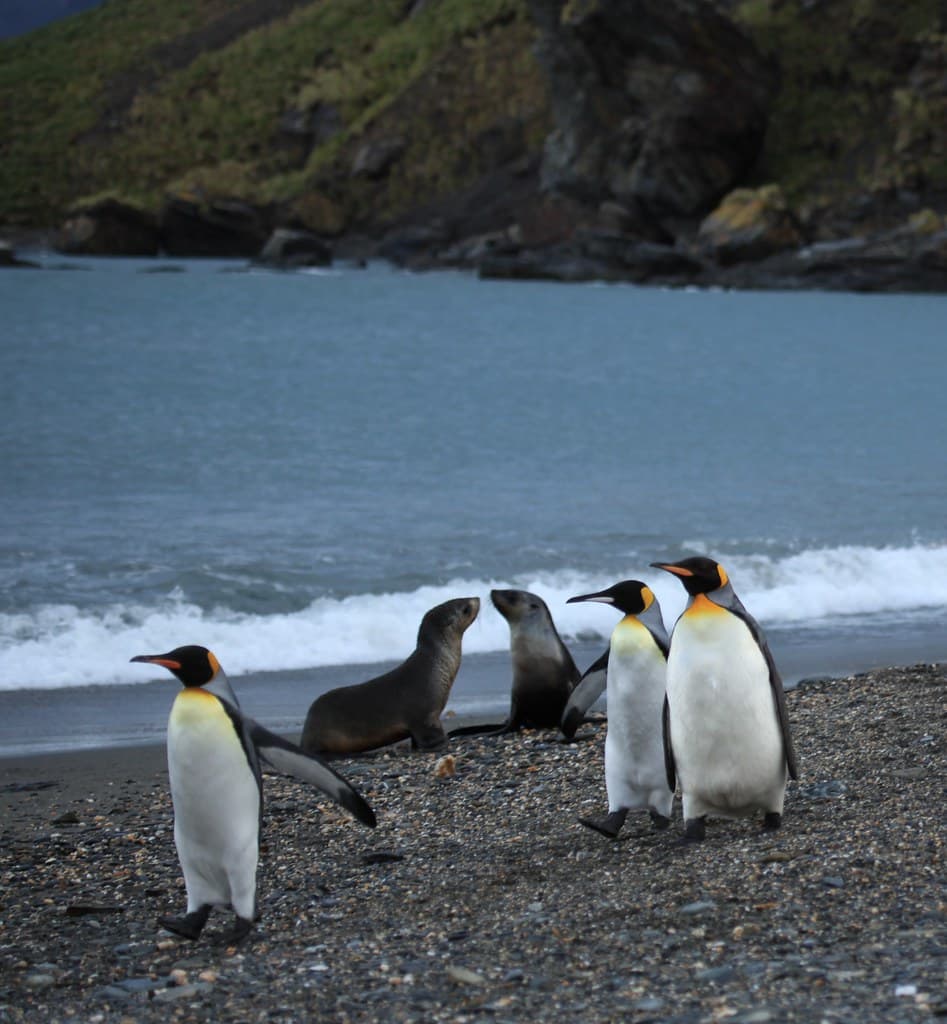
“You step onto rounded pebbles polished by ice-melt streams, the air alive with braying calls that echo off snow-dusted peaks. King penguins waddle past your boots in processions so dense you'll need to pause mid-stride.…”
Limited recent visitor reports — live OBI telemetry is your best guide for current conditions.
The pebbles shift beneath your feet as you navigate the margins of a living tapestry—chicks in downy brown coats huddle beside adults whose orange auricular patches glow against slate-gray skies. Glacial streams carve braided channels through the beach, carrying sediment from the mountains that rise sharply behind Grytviken's abandoned whaling station. The wind carries brine and guano, an earthy musk that mingles with the cold bite of Antarctic air.
Elephant seals sprawl across the foreshore like boulders made flesh, their guttural belches punctuating the colony's constant chatter. You'll watch skuas patrol overhead, eyeing unguarded eggs, while fur seals claim stretches of shoreline with territorial displays. The scale defies your expectations—penguins stretch toward the tussock grass in a sea of orange, black, and white that shifts and ripples like a single organism.
Credit: FlickrPhotograph King Penguins
Frame chicks against mountain backdrops
Walk marked paths near seals
Capture molting bulls on foreshore
Prime Visitation
Best Weather | Less Crowds
Where it is
St Andrews Bay Beach
Grytviken, Antártida e Islas del Atlántico Sur, Argentina
-54.438900°, -36.181700°
Weather
Loading…
Swell
—
Temp
Warm · Restorative
UV Index
Moderate
Wind
—
Tidal State
Last known
Max Sunlight
—
Ideal Shade
—
Jan - Dec (Peak)
Mar - Nov (Off-season)
Best Weather | Less Crowds
Select a category to load nearby places.
Unlock restaurants, luxury stays and curated maritime experiences within 2km
Walking at St Andrews Bay is safe when following strict wildlife guidelines under expedition staff supervision. Visitors must maintain 5-meter distance from king penguins and avoid blocking their routes to the sea. Fur seals pose greater danger, particularly bulls during breeding season; they can be aggressive and move faster than humans. Never approach or walk between fur seals and water. The beach can have streams and muddy sections requiring careful footing. Weather hazards include sudden storms, strong winds from the glacier, and cold temperatures. Landings only proceed in suitable conditions, and experienced guides manage all movements to ensure visitor and wildlife safety.
The only access period is austral summer, November through March, when expedition cruises operate to South Georgia. St Andrews Bay's king penguins breed asynchronously, so impressive numbers are present throughout the season. December and January offer peak chick viewing, with thousands of fluffy brown chicks among adults. November shows courtship and early breeding; February-March features advanced chicks and moulting adults. Each month provides different behaviors and photographic opportunities. Weather is relatively most stable December through February, though conditions remain unpredictable. Most expedition itineraries visit during January for optimal wildlife activity and weather probability, but any summer month offers extraordinary experiences.
St Andrews Bay is accessible only via expedition cruise ships, as South Georgia has no airports, ports, or regular transport services. Ships depart primarily from Ushuaia, Argentina, crossing the Drake Passage and Scotia Sea over 2-3 days. Passengers reach the beach via Zodiac landings from ships anchored offshore. The landing involves a wet beach landing requiring waterproof boots and agility. Weather and swell conditions determine whether landings proceed; they can be cancelled despite the long journey. All visits require permits from the South Georgia government and must comply with strict environmental protocols. The voyage typically requires 10-14 days including transit and multiple South Georgia landings.
St Andrews Bay is completely wild and uninhabited, with absolutely no facilities, buildings, or infrastructure. Visitors experience pristine wilderness with no bathrooms, shelters, or services of any kind. All accommodation, meals, and facilities are aboard expedition ships anchored offshore. Landings typically last 2-3 hours before returning to the ship. There are no marked trails; visitors walk carefully through the terrain under expedition guide direction. The nearest settlement is Grytviken, several hours away by ship, which itself offers no tourist accommodation. This complete absence of development preserves the bay's pristine character and protects one of the world's most significant king penguin colonies.
St Andrews Bay hosts one of the world's largest king penguin colonies, with approximately 150,000 breeding pairs creating an overwhelming wildlife spectacle. The vast river plain behind the beach fills with hundreds of thousands of penguins extending to the glaciers, creating scenes unmatched anywhere else. The dramatic backdrop features the Cook Glacier and surrounding mountains, providing extraordinary photographic compositions. The sheer scale and density of wildlife, combined with pristine sub-Antarctic scenery, creates one of the planet's most impressive natural phenomena. The cacophony of penguin calls, the movement of masses of birds, and the raw wilderness setting create an unforgettable bucket-list experience.
Photos